



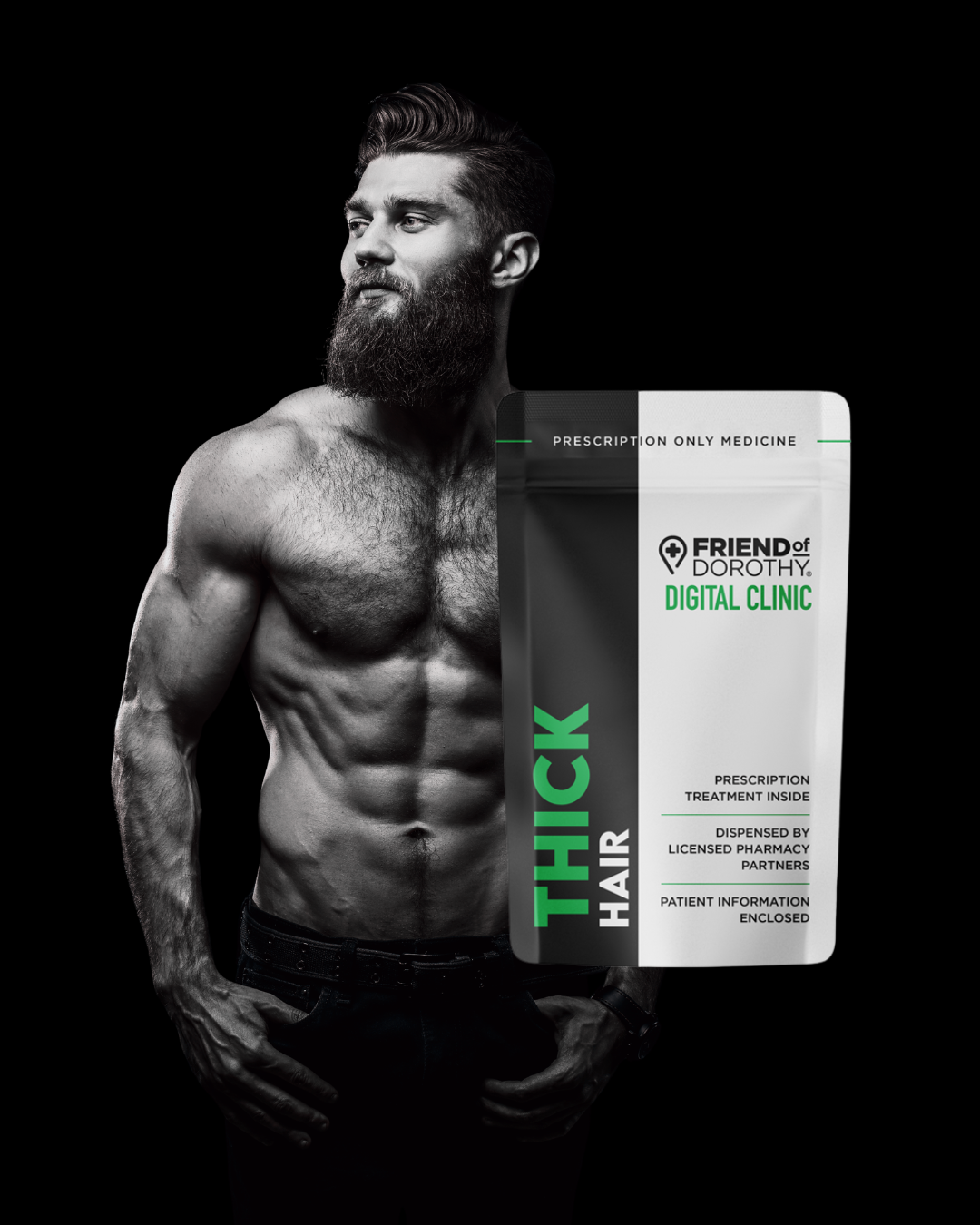
READY TO FIGHT
FOR YOUR HAIRLINE?
That receding line in the group photo? Caught early, it's one of the most treatable things going.Hair loss feels like it happens overnight — it doesn't. It creeps. And the single biggest factor in keeping your hair is how early you start. THICK HAIR is a doctor-assessed treatment that works to slow the loss and support regrowth, prescribed only if it's right for you. The clock's the enemy. So let's start it.
GET STARTED FROM £39.99Evidence, not hype. THICK HAIR is built on the most clinically established, regulator-recognised approach to male pattern hair loss in the UK — and it's the only one you take as a simple daily tablet. It's prescribed only after a UK-registered clinician confirms it's right for you.
You noticed it in the photos first
The flash catches the crown. The hairline looks further back than you remembered. Suddenly you're tilting your head on every selfie and clocking every other guy's hairline on the apps. In a scene that can be brutal about youth and looks, that quiet panic is real — and you're allowed to do something about it. Here's the good news: if you've noticed it early, you've got options most men miss by waiting.

Free CUM XXL worth £64.99
Shoot your biggest load · More intense orgasms
Complete your consultation and our bestselling CUM XXL Volume + Vitality supplement is added to your first order automatically — no code, no extra steps. While stocks last.
18+ · UK only · One per patient · Added automatically to your first order · While stocks last · CUM XXL is a food supplement, not a medicine
It's coming for most of us
Male pattern hair loss isn't rare or unlucky — it's the default for the majority of men, and it starts younger than you'd think. Sources are at the bottom of this page.
Of men get male pattern hair loss in their lifetime1
It's not an if for most of us — it's a when. Which is exactly why getting ahead of it matters.
Start before they're 212
Around a quarter of affected men see the first signs in their teens or very early twenties.
Notice thinning by 353
By your mid-thirties, most men have clocked a receding line or a thinner crown — whether they admit it or not.
Have visible loss by 504
Roughly half of all men by fifty — and the grade tends to climb with every decade.
Of it is hereditary & DHT-driven5
The vast majority of male hair loss is genetic, driven by a hormone called DHT shrinking the follicle — which is exactly what treatment targets.
Your hairline is doing more than you think
Ask men what hair loss actually costs them and it isn't vanity — it's confidence. In a peer-reviewed European study, over 70% said their hair is an important part of their image, and 62% agreed losing it knocks their self-esteem, with getting older a recurring worry. The thing men most often name as the worst part isn't the hair itself — it's feeling less sure of themselves.6
In the room
Walking in, holding eye contact, owning the space — it's harder when you're convinced everyone's reading your hairline before they hear your name. Keep your hair and you keep that ease.
On the apps
When the first photo is the whole first impression, the receding line you obsess over becomes the thing you hide behind — cropping, filtering, angling. Confidence reads in a profile, and it reads in person.
In bed
Good sex runs on feeling wanted, present and unselfconscious. When you're not stuck in your head about how you look, you show up fully — and the way you feel in the mirror has a habit of following you under the covers.
This isn't about chasing 22 forever. It's about not letting a hairline decide how you feel walking into a room — at any age.
It's still not too late
Hair loss moves through recognisable stages. The earlier you act, the more there is to protect — and the simple rule below tells you whether you're still in the window.
Full head
No real loss yet. If it runs in the family, this is the time to get ahead of it.
BaselineHairline receding
The temples creep back first. Caught here, you're in the best possible spot.
Best time to actThinning crown
That spot you only catch in flash photos. Still very much treatable.
Still in timeBit of both
Front and crown going together. Don't wait — you're at the edge of the window.
Act nowSmooth on top
Smooth and shiny for years? Honestly, this likely won't help — and we'll tell you straight.
Likely too lateThe rule of thumb: if there's still hair where you're thinning — even fine, wispy hair — the follicles are alive, and that's exactly who this is for. Once the skin is smooth and shiny, the follicle is usually gone for good. So the honest answer to “is it too late?” is almost always: not if you act now.
Every month you wait, you lose ground
Follicles don't fall off a cliff — they shrink, cycle after cycle, until they stop for good. That's why timing is everything: you're protecting what's still there.
Illustrative only. This shows the progressive nature of male pattern hair loss — follicles miniaturise over time and, once truly lost, don't come back. It is not based on any specific product's trial data, and individual results vary.
What to expect, honestly
Any real hair treatment takes time — anyone promising overnight results is lying. Here's the realistic journey your clinician will talk you through.
Settling in
You start. Some men notice a little extra shedding early on as the hair cycle resets — it's common and usually a sign things are changing, not a setback.
Too early to judge
Tempting to inspect daily, but it's genuinely too soon. Consistency is the whole game here — daily use is what makes or breaks it.
The turn
This is roughly when many men start to notice a difference — less in the plughole, a crown that photographs better.
The honest picture
Around a year is when you fairly judge it. Keep in mind it works while you use it — stop, and loss resumes over the following months.
The best time was five years ago.
The second best is today
You can't get back what's gone — but you can protect what's there. A free 2-minute check tells you if you're still in the window.
Check if you're in time →Discreet. Daily. Doctor-led
Quick online check
A few questions and a couple of photos of your hairline and crown. Takes about two minutes.
A clinician reviews you
A UK-registered prescriber checks it's appropriate and safe for you and confirms whether you're in the treatable window — honestly, even if the answer's no.
Delivered discreetly
If suitable, your treatment is dispensed by licensed pharmacy partners and arrives in plain, unmarked packaging.
One small tablet a day
A simple once-a-day tablet — that's the whole routine. Your clinician explains exactly how to take it and checks in on your progress.
Are you still in time?
Tick what applies. Final suitability — and safety — is always confirmed by a clinician.
Based on what you've told us, THICK HAIR could be right for you. The next step is a short assessment with a UK-registered prescriber, who confirms it's appropriate and safe before anything is prescribed.
Guidance only — not a diagnosis. Final suitability and safety are decided by a registered prescriber after a full assessment.
A clinician can still look at your situation and tell you honestly whether treatment would help — there's no wrong reason to ask.
Guidance only — not a diagnosis. Final suitability and safety are decided by a registered prescriber after a full assessment.

Dispensed by a real, UK-registered pharmacy
We're the digital health service — the front door, the questionnaire, the experience designed for gay men. The actual prescription is dispensed by a fully GPhC-registered UK pharmacy partner. That's how it has to work by law, and it's how it should work. We don't pretend to be a pharmacy. We work with one.
That means your medication goes through the same checks any prescription would at the high street pharmacy — but without the awkward bit. Same regulated UK supply chain, same quality, same standards. Just in a plain brown box on your doormat.

Straight answers, no snake oil
Yousef Yaghoubi has extensive experience in men's health and patient care. He oversees Friend of Dorothy's Digital Clinic because the hair-loss world is full of hype, and men deserve an honest assessment — including being told when something won't work.
Every request is reviewed by the clinical team — never an algorithm, never a chatbot.
Start your assessment →What they're saying
Started the second I noticed the crown going. Six months in and I've stopped angling my head in every photo. Just wish I'd done it sooner.
What sold me was the honesty — they actually told a mate of mine he'd left it too late rather than just taking his money. So I trusted them with mine.
Once-a-day, plain packaging, done. The check-in about side effects up front made me feel like an actual patient, not a customer.
The stages diagram is what got me to act — realised I was bang in the middle of the window. Easy decision after that.
Discreet, simple, and a real clinician reviewed my photos. Felt safe and legit the whole way through.
Confidence back, hairline holding. For the dating scene that's worth a lot more than the price.
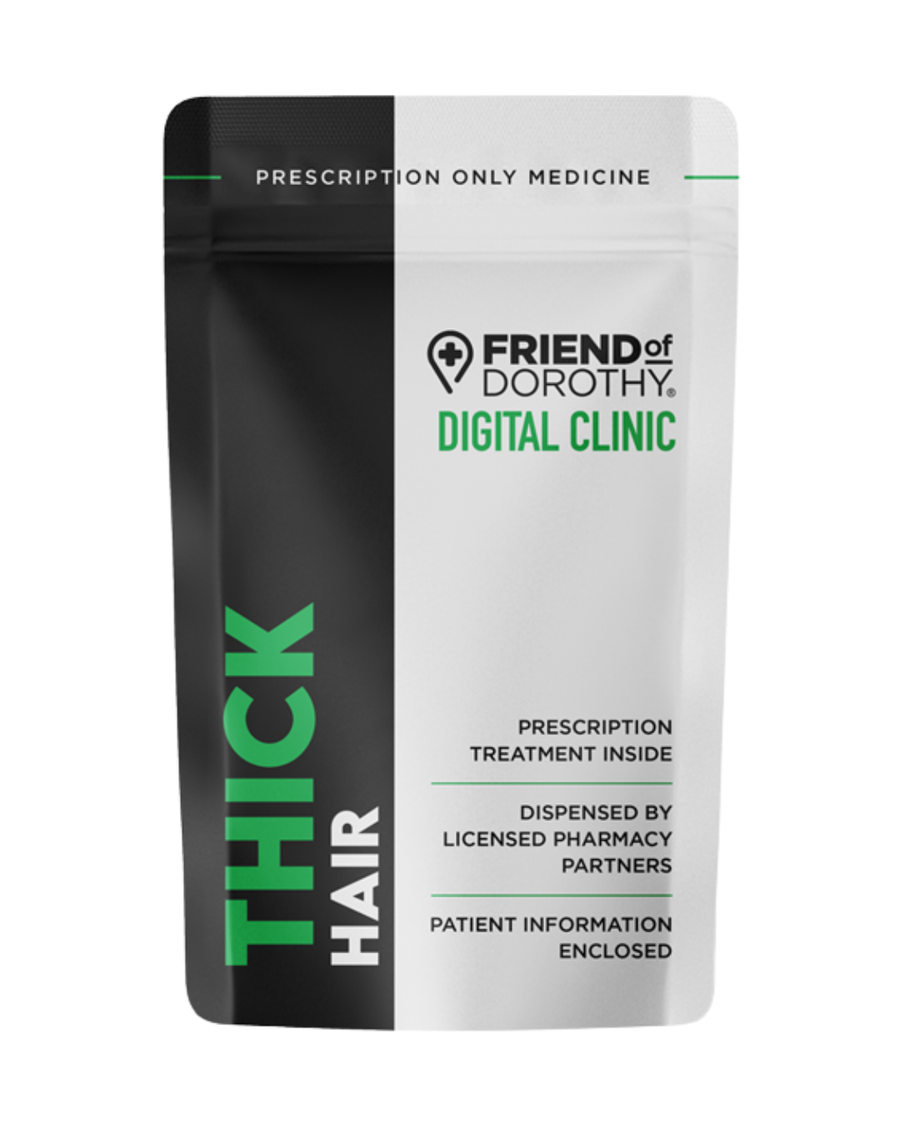
THICK HAIR
Once-daily tablet · Prescription only · UK licensedA once-a-day tablet that targets the root cause of male pattern hair loss from the inside — prescribed only where it's right and safe for you.
- Lowers DHT — the hormone that shrinks the follicle and drives most male hair loss
- Works to slow the loss and help you hold onto what you've got
- One small tablet a day — that's the whole routine
- Assessed and prescribed by UK-registered clinicians, dispensed by licensed pharmacy partners
- Plain, unmarked packaging — complete discretion to your door
DON'T WAIT
TILL IT'S GONE
The follicles you protect today are the ones you keep. Take the free 2-minute check and let a UK-registered clinician take it from there. Free to get assessed. Only pay if it's right for you.
See if you're still in time →The honest answers
It's a once-a-day tablet that lowers DHT — the hormone behind most male pattern hair loss — the same clinically established approach behind the best-known hair-loss treatments. Your clinician confirms the exact medicine and dose that's right for you.
The honest test: if there's still hair where you're thinning — even fine, wispy hair — the follicles are alive and you're likely a candidate. If the skin is completely smooth and shiny after years of loss, the follicle is usually gone and this won't bring it back. We'll tell you straight either way.
Real hair treatments take months, not days. Many men notice changes around the 6-month mark, and around 12 months is when you can fairly judge it. Daily consistency is the single biggest factor — and it keeps working only while you keep using it.
Yes — and we won't bury them, especially on a brand like ours. Because it lowers DHT, a small number of men can experience sexual side effects such as reduced libido or changes to erections or ejaculation. For most men these are uncommon and often settle, and they typically reverse if the medicine is stopped — but they're real, which is exactly why a clinician assesses you first and checks in afterwards. If anything feels off, tell them straight away. The UK medicines regulator (MHRA) has also flagged rare reports of mood changes — including low mood or suicidal thoughts — in some men taking it; if your mood shifts at all while using it, stop and seek medical advice promptly.
It works while you use it. If you stop, the hair you've protected will gradually be lost again over the following months — so think of it as ongoing maintenance, not a one-off course. Your clinician will talk you through what that looks like.
Anyone who is or may become pregnant shouldn't handle crushed or broken tablets, as the medicine can affect a developing baby. The tablets are coated, so handling whole tablets normally is fine. Your clinician will go through safe use with you.
No. Everything arrives in plain, unmarked packaging with nothing on the outside to show what's inside or who it's from.
Take the free check above — about two minutes, no obligation. You only pay if a clinician decides it's right to prescribe.
THICK HAIR is a prescription-only treatment, available only after a consultation with a registered prescriber and only where clinically appropriate and safe. It is intended for men aged 18 and over and is not suitable for everyone. It contains finasteride; crushed or broken tablets should not be handled by anyone who is or may become pregnant. As with all medicines, side effects are possible — including, in a small number of men, effects on sexual function and, rarely, mood changes (the MHRA advises stopping and seeking advice if mood is affected). It works while used; benefits are gradually lost if treatment is stopped. Information on this page is general and not a diagnosis.
Sources & references
Up to 80% of men experience pattern hair loss (androgenetic alopecia) in their lifetime — National Library of Medicine, summarised in Chemist4U hair-loss statistics. chemist-4-u.com
Around 25% of men with androgenetic alopecia see signs before age 21. kopelmanhair.com
Roughly two-thirds of men notice some thinning by age 35. kopelmanhair.com
Male pattern baldness reaches ~50% prevalence by age 50 (Hamilton; large-scale GWAS, Nature Communications / NCBI). ncbi.nlm.nih.gov
~95% of male hair loss is androgenetic (hereditary, DHT-driven). chemist-4-u.com
“The psychosocial impact of hair loss among men: a multinational European study” (Germany, France, Italy, Spain, UK; men aged 18–45): over 70% considered hair an important feature of image and 62% agreed hair loss could affect self-esteem. pubmed.ncbi.nlm.nih.gov
Friend of Dorothy Digital Clinic · Superintendent Pharmacist: Yousef Yaghoubi, GPhC no. 2218268
THICK HAIR is a prescription-only treatment, available only after consultation with a registered prescriber and only where clinically appropriate and safe. It is intended for men aged 18 and over and is not suitable for everyone. It contains finasteride; crushed or broken tablets should not be handled by anyone who is or may become pregnant. Side effects are possible — including, in a small number of men, effects on sexual function and, rarely, mood changes (the MHRA advises stopping and seeking advice if mood is affected). It works while used; benefits are gradually lost if stopped. Information on this page is general and not a diagnosis.
